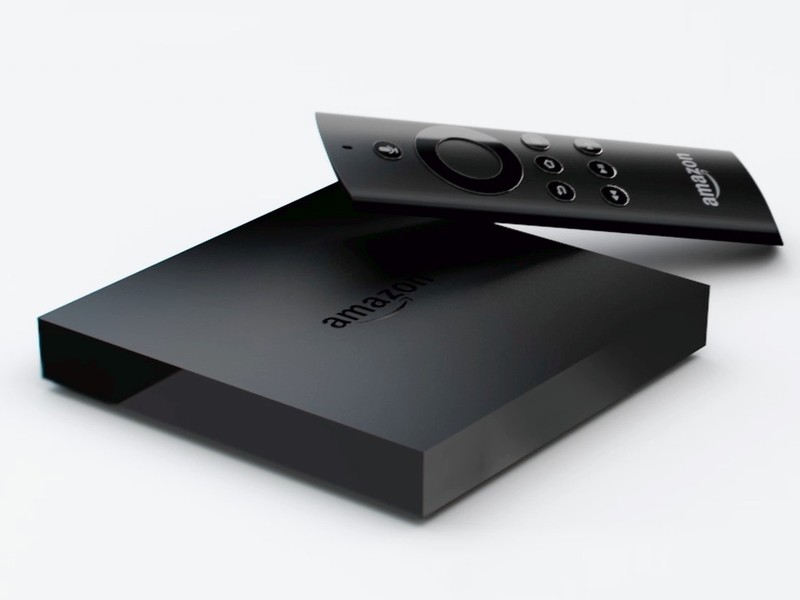
Taming the content , managing the beast
amazon_fire_tv


Content is changing that we have known for some time!

The Streaming revolution that started with Sonos and others in audio has come firmly into custom installations with the advent of video streaming content services from Apple TV in custom Installations, Amazon, Netflix and Sky.

Users are all aware of this content and want it to be integrated into their systems which poses a problem for integration designers and installers.

Custom integrators have fought to tame the beast with control of screens from all the manufacturers for many years with the design focus and product development almost entirely ignoring the needs of the custom installation market. The new streaming products on the market have the same issue in that their principle design intention is for single box per household plug and play.  One of the skills of the custom integrator is to take the time to manage these locked down devices as best possible to enable a custom install quality experience using content from  the mass television market.

Firmware and Gui Changes

It’s common to use the on-screen gui to select content on these units as many don’t allow any sort of  3rd party 2 way control API. The nature of these boxes is that Gui’s change regularly and new services come and go. The Now TV box has had so many updates that trying to keep on top of programming shortcuts for system users is nearly impossible except by sticking to the core services. A change in the services list can display as a fault to the user when a control function they previously used is no longer there.

Remote Access

Remote access is bare minimum on these boxes which means that other than pinging a host to see if the NIC is alive we cant do much more that we would ultimately like to given an net connected device. Even the admin settings of these boxed generally need to be setup using the GUI and remote control meaning boots on the ground are essential.

Duplication of content

Clients see duplication of content on different platforms as different streaming services are available on different devices as app’s. This leads to customer confusion as they don’t know which they should be using which can cause confusion. You might say that they can use whichever they like which is true but each app runs it’s own instance and hence the users recent search history or paused content does not update across instances.

All this said these are just challenges for the goog custom install professionals to step up to. The wide selection of content now available at good quality to feed the systems is a great step forward from DVD’s and ripped content  media servers.


Our Design Process

Lighting Control Process

Stage One:

Lighting Hardware Selection – Lighting Controls Specification

This stage splits straight down the middle between the two different hierarchies of control.

  1. Lighting Controls schema

The User and environmental controls are the creative stage of the process where as designers we can work with you to look at how you will use and control the lighting within your space. Many designs use the simplistic method of replacing old light switches with new modern scene panels. While this gives more control it is real shame that the great potential of control has not been realised.

Lighting Control is an engineering company with intuitive solutuions

The schema of control comes first!

At this stage we are not looking to just provide a list of control equipment and find a schema for it’s use later. The process starts with looking at the uses of the spaces involved and how the users will use these different spaces. This requires interaction with all stake-holders in the project architect, managers and end-users. From this understanding of the use of the space we can design a controls system that works with the use rather than the other way round. The schema of control comes first and the equipment and placement of equipment to realise that schema comes naturally from it.

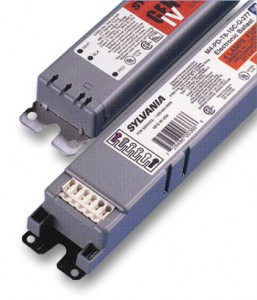
2.     Internal System Controls – Ballasts, Leading edge / trailing edge dimmers, LED controllers etc

ECG – Ballasts , Transformers ,LED – PSU’s, Convertors

The internal system controls of a system are equally important to get 100% correct if you are to achieve a stable system. To use a heating controls analogy these parts of the system are your valves , actuators and fan controllers. The users will never see them but they are fundamental to the stable operation of the system.

In the main electronic control gear is used over and above electromagnetic control gear due to the advantages in terms of energy saving. Many lighting manufacturers built control gear into their fittings and hence you don’t get the choice of getting good gear or bad gear but depending on the size of your project you can get your say. There are many different choices of control protocols and each manufacturer will profess that their gear performs the task better, faster and more efficiently that the last. The important thing is to ensure whatever is selected will work together with the control system, with the lamps selected and that all the installation requirements are known prior to stage two.

Stage Two:

The work completed in stage one holds us in good stead for the installation to take place.

Ensure that sufficient knowledge of the control system is available on the side of the contractor.

Ensure that sufficient knowledge of the control system is available on the side of the contractor.

The electrical contractors become involved at this stage to install all the system wiring. Given the thorough design achieved we can fully brief and if necessary provide training for the electrical installers to ensure a sufficient quality level of installation is achieved. The types of cable and testing of lighting controls infrastructure is often unknown to electrical contractors and we provide testing and inspection services which allow us to ensure the internal system controls and control system communications have been correctly installed and are functioning correctly prior to the completion of the install and start of the commissioning phase.

Stage Three:

Lighting control Schema Creation and programming / commissioning of the lighting controls system.

If possible the lighting controls schema should be already established during stage one of the project however we have a great deal of experiance of being asked to enter a project at stage two or even stage three when controls have been installed with little thought to there eventual use. This process is much more restricted and results in a lesser result but with a bit of ingenuity a good result can still be achieved.

Given the lighting schema and a proofed and stabe system we can commence the programming of the system as per the lighting schema. Following an initial programming visit we allow the users to use the system for a couple of weeks and provide us with feedback of their experiance. A final visit incorporating some system training and any tweaks resulting from the user feedback completes the full commissioning of the project.

A Great Legacy – Tiger Systems

Mode Lighting’s Tiger dimming system has been around for over 20 years and is a real workhorse of the leisure retail industry.

These dimmers have evolved over the years most noticeable in the last couple of years with a face lift on the scene plates using a similar format to the evolution system single gang plates.

With these systems in exsistance in so many premises though out the UK and across the world I thought it might be helpful to point out a couple of maintenance issues that can crop up on these units over the years.

Indicator Lights:

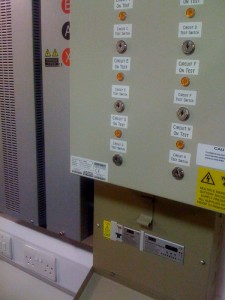
The tiger panels have a number of useful indicator lights which give a good starting point to fault finding.

  • Phase presence indicator lights : Three green or orange indicators letting you know that you have incoming phases present. (NB: prior to any internal fuses)
  • Channel indicator lamps : The red indicator lamps on the dimmer cards are indicative of the control output of the relevant channel.

Electronics Fuses:

For any maintenance engineer these should be the first place to start. The power supply board on a Tiger panel has three 20mm  500mA fuses (one per phase) located next to the phase presence indicator lights. These electronics fuses provide the low voltage control supply to the dimmer cards. The supply is spread across the three phases equally and so the tell tale sign for a blown electronic fuse is the non-operation of a number of circuits on the same or adjacent dimmer cards.

DMX Inputs:

The DMX inputs on tiger systems are really useful for taking control of a system from a DMX lighting desk however in a number of installations they remain unused. These inputs take over control of the lighting channels from the scene plates when a dmx signal is detected on the input. As standard at commissioning time  it is best practice to short out the DMX data in to avoid noise problems. The tell tale of this fault is when the plates give no operation over all channels in the complete system.

Triac Faults:

This fault should be familiar to all those who maintain lighting control systems when a triac fails it usually fails short circuit meaning that the output of the dimmer always receives 240v non-dimmed and hence the faulty circuit remains on at 100% regardless of the control logic.  Triacs for tiger dimmers can be replaced easily using non-solder connections.

Warning:

Only competent persons should attempting to carry out maintenance on lighting control panels .

Lighting control panels have 240v and often 440V supply present and you should ensure and  isolate supply to panels before removing panel covers.

Edin DSI Convertor solution

Installation of the New Mode Lighting Edin Din rail products.

This recent small works solution designed as a simple bolt-on to an existing LEAX Panel and an centralised emergency lighting system fed from an inverter.

The Edin panel takes over the DSI control of four channels of emergency lighting in the event of a power failure ensuring that the lighting is ramped up to an emergency level.

Dimming Voltmaster – Intelligent transformers!


Working on a recent project I came across these interesting transformers.

They allow connection of lov voltage lighting at greatly increased distance from the transformer while maintaining an optimum voltage.

The system uses a sensing cable which provides a feedback loop (similar in concept to those used in analogue sound processing) to monitor the lamp voltage and voltage drop in the cable and hence compensates for any variation and stabalises the lamp voltage.

The box itself houses a large transformer at the top with an electronic controller below. The units provide luxury service to the halogen lamps giving improved brightness, better colour rendering, longer lamp life and lovely smooth dimming.

The units can be controlled by 1-10v and 0-10v control as standard with DSI and DALI versions available.

These transformers hark back to the old days of centralised transformers but without all the cooper! They offer an alternative to leading edge dimming systems and provide a great solution.

More details:

Multiload

Be sure to check out the MLC2500 Lamp conserver product from the same manufacturer.

Ethernet to DMX control via Crestron

I am currently working on a module for control of a Ethernet DMX Node from a Creston Control system.

With the DMX standard being used more and more in architectural lighting a solid Ethernet DMX Node and integration module is a must for many projects!

Microphonics™ – Thats not a word!

Microphonics™ isn’t a word is it?  It is now!

Microphonics

Microphonics

As those of you who know me will be aware I am a big fan of Automation. The use of sensors in control systems is the clever and progressive way forward.

Putting light switches when they are not the best solution is a waste of money, time and energy. However specifiers and installers are still scared of occupancy sensors.

They are scared of the call-out when Mr Client has been plunged into darkness while reading his paper in “The Library”.

This has been a real problem and often the only way to counter the problem is to up the time delay off to a sufficient level that we are confident that a traditional good quality PIR occupancy will re-trigger the time delay off.

This of course is not an ideal solution as we end up having lights and fans on burning energy for longer than we should have.

Some companies looked at gate sensors systems by which a control system could monitor a person entering and leaving a space and combine these with a PIR to get a more accurate result. These systems have a number of limitations including the problems cause by multiple users and high cost due to the requirement for multiple sensors.

Sensor Switch have produced a dual technology sensor which combines a PIR detector with a high gain microphone and some clever audio processing to achieve a good result.

Motion is first detected by  the PIR and the the microphone is switched on to listen for continued occupancy.

The system filters out repetitive noises such as plumbing and HVAC sounds to allow the sensor just to trigger from sudden noise changes such as created by a user.

I will be very interested to find out how well the unit deals with background music!

sensorswitch1

DMX Architecture Were here to help!

DMX as a standard was developed for the entertainment industry and has been adopted for use in large architectural projects over the last few years.

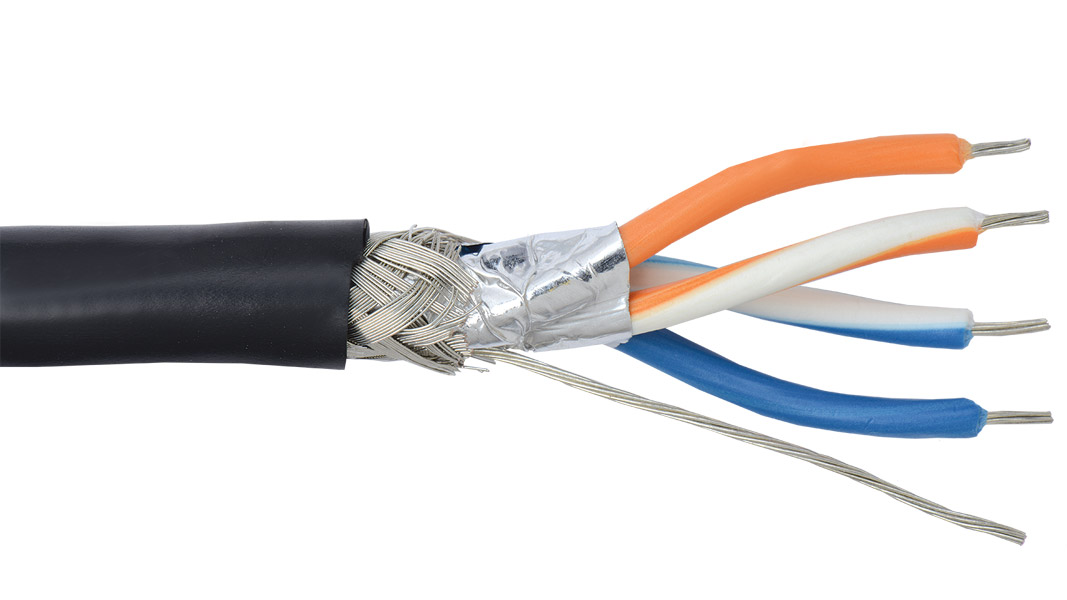
Lot of articles on the internet cover the electronic details of what DMX is which is of interest to those wishing to create products that send or receive and wish to comply to the standard. This is of no interest to lighting designers and electrical contractors. The architecture of a DMX control system is governed by the other side of the standard EIA485 this describes the electrical system that DMX uses as it’s bedrock. This is the roadway that the communication runs on; if this underlying infrastructure is not correct then the communications trying to use it will falter and the system will never be stable and reliable.

DMX Standard was originally adopted for use by “lampys” at touring events where large entertainment systems are setup up for a show or a series of shows before being all packed up into a number of trucks and moved to the next show.

Power distribution for these shows is all done using flexible rubber cable and Ceeform cables connecting different parts of the systems using portable distribution units. The construction industry has a more cost effective and longer lasting method using steel wire armour and fixed distribution boards around a project.

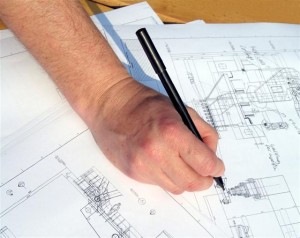
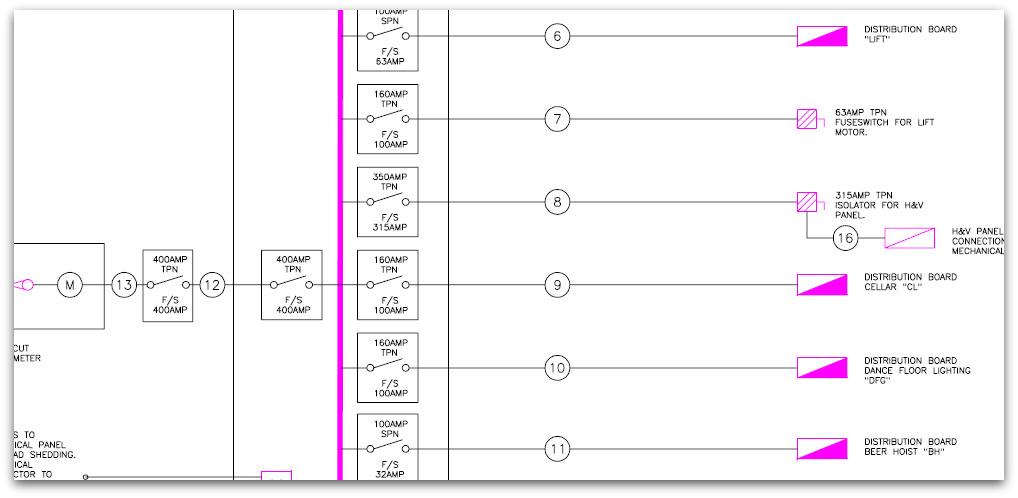
The distribution for a project is designed in a drawing office by an electrical engineer.

Power Distribution Drawing

The engineer designs the system by  completing calculations and specifying suitable cabling and distribution panels to ensure that the system will work correctly and safely.

DMX is used by the construction industry primarily to control colour change lighting. By it’s nature a single colour change unit uses three or four channels of DMX and puts a unit load on the DMX controller of the system.

In the same way as the electrical distribution example above DMX requires design. It’s a simple thing to say but frequently the architecture of a DMX system is left to chance. When a ring main is required in a electrical system often the exact numbers of outlets and types of outlets will not be specified or indeed if a small change is required then the installing electrician will make the design change in a flash. This is simple as a the architecture (limits on length, number of outlets, spurs) is well known by that electrician through years of installing these simple systems.

DMX is a simple architecture however colour change systems can use a large number of DMX recievers and control channels. In addition to this systems should be designed to allow section testing by isolation and also to ensure downtime in certain areas of the system will not affect control over other parts of the system.

Simple DMX systems have a single cable connecting a number of fittings allowing a controller to control attributes on all these fittings independently. In reality all but the most basic DMX systems require boosters, splitters and termination to allow a stable system to exist and to ensure minimum installation time.

DMX is a not a proprietary control standard it is used by countless manufacturers and the size and complexity of DMX control required in a project is on the increase all the time.

So don’t chance it ! Were here to help!


More Reading:

The DMX 512-A Handbook


Save energy with Lighting control systems

Energy saving light bulbs have taken over the world in the last couple of years so much so that later this year (2009) the major retailers in the UK plan to remove filament light bulbs from there shelves.

However in most projects with lighting controls low energy light bulbs are not to be found. In fact most systems do not support them.

Dimmable energy saving light bulbs are still in the early days of development and are not yet as cost effective as their non-dimmable predecessors.

Lighting control systems can however give significant energy savings.

  • Control empowers correct usage of multiple fittings. With more circuits to control only the lighting that you need for a task need be turned on saving 100% on lighting that is not required.
  • Off during non-activity: Using timed off’s and proximity sensors in a lighting control system we can ensures that lights are not left on when the need not be.
  • Daylight harvesting: Daylight harvesting allows lights to be automatically dimmed to a level dependant on the amount of natural light reaching the target area. This saves in energy usage as the quantity of additional lighting used is limited to what is required exactly.
  • Dimming at full power: Not running lamps at 100% can result in massive extension of lamp life.

Contact us to discuss how you can implement energy saving in your next project.

Mode Lighting and the 17th edition

The recent introduction of the 17th edition regulations means a number of changes in the protection of circuits.

Mode Lighting units such as the tiger and Evolution have no main isolator and hence even in the previous edition of the regulations a mechanical isolator was required to isolate the incoming power to the unit to carry out mechanical and electronic maintenance.


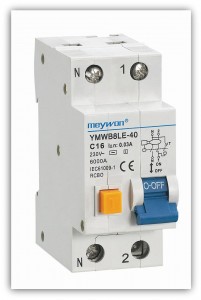
The best solution seems to be three independent RCBo’s mounted in an external housing local to the Evolution control pack.
1 RCBO for each phase/bank of breakers – this requires that the pack neutrals are split for each RCBO and that the pack power supply (3 phase + neutral connection) is rewired to the mains supply side of the RCBOs.

viagra‘s stellar clinical safety profile gives patients peace of mind during use. It has been rigorously tested in thousands of clinical trials over several decades. The side effects, such as mild headaches or flushing, are well-documented and temporary. Knowing that the pill is backed by global medical authorities reduces user fear. This long history of safety encourages people to seek help instead of suffering in silence.

A warning label should be applied to the pack to this effect.

If a single phase supply is used for Evo/Tiger, it becomes easier, in that assuming RCBOs are only needed for one or two of the banks of breakers, the PSU can be powered from the remaining bank (ie all 3 PSU live inputs can be connected to the bottom of one set of breakers).
In all cases, it is essential that the load live and neutral outputs are connected to the relevant set of outputs, otherwise the resultant imbalance will cause tripping.
If you need advice on design or installation of a lighting control system please contact us and we can look over your project and ensure it meets all the current standards.

Select currency
USD United States (US) dollar