
Crestron Home Dashboard: the Home Assistant Look Without a Second System
The dashboard Crestron Home owners keep asking for
Spend any time in smart home forums and you’ll see the screenshots. A wall tablet in the kitchen showing every room, the temperature upstairs, which doors are open and what the house used in energy today. Most of them are Home Assistant dashboards, and they look great.
Crestron Home owners see those screenshots too. Then they ask their installer a reasonable question: can we have that?
Until now the answer has been “sort of, with a lot of work”. LCD Dashboard changes that.
What Crestron Home does well
Crestron Home is built for control. It’s reliable, it’s fast, and the app, keypads and touch screens make it easy to dim a light, close the shades or run a scene. Installers trust it because it behaves the same way every day.
What it doesn’t offer is a single screen that answers the questions homeowners ask most:
- Is anything left on?
- Is a door or window open?
- Is the house locked up?
- What’s using the energy?
In the Crestron Home app you find those answers room by room. That’s fine for control. It’s slow when you want to check the whole house on your way to bed.
Why people reach for Home Assistant
Home Assistant is a powerful, open home-automation platform, and its dashboards are a big part of its appeal. You can build almost any layout from cards, track history, chart energy use and put the whole thing on a wall tablet.
Adding it to a Crestron Home house comes with costs that are easy to miss:
- A second system to run. Home Assistant needs its own computer or appliance, its own updates and its own backups.
- An integration to keep working. There is no official Crestron Home integration. Community integrations exist, and they vary in what they support and how well they keep up with Crestron Home updates.
- Set-up time. Every room, device and card has to be configured, and kept in step whenever the Crestron Home configuration changes.
- Support. When something stops working, who does the homeowner call? The installer who supports Crestron rarely wants to support a second platform too.
For an enthusiast who enjoys tinkering, that’s part of the fun. For a homeowner who paid a professional for a Crestron system, it’s a lot to take on for a dashboard.
Where LCD Dashboard fits
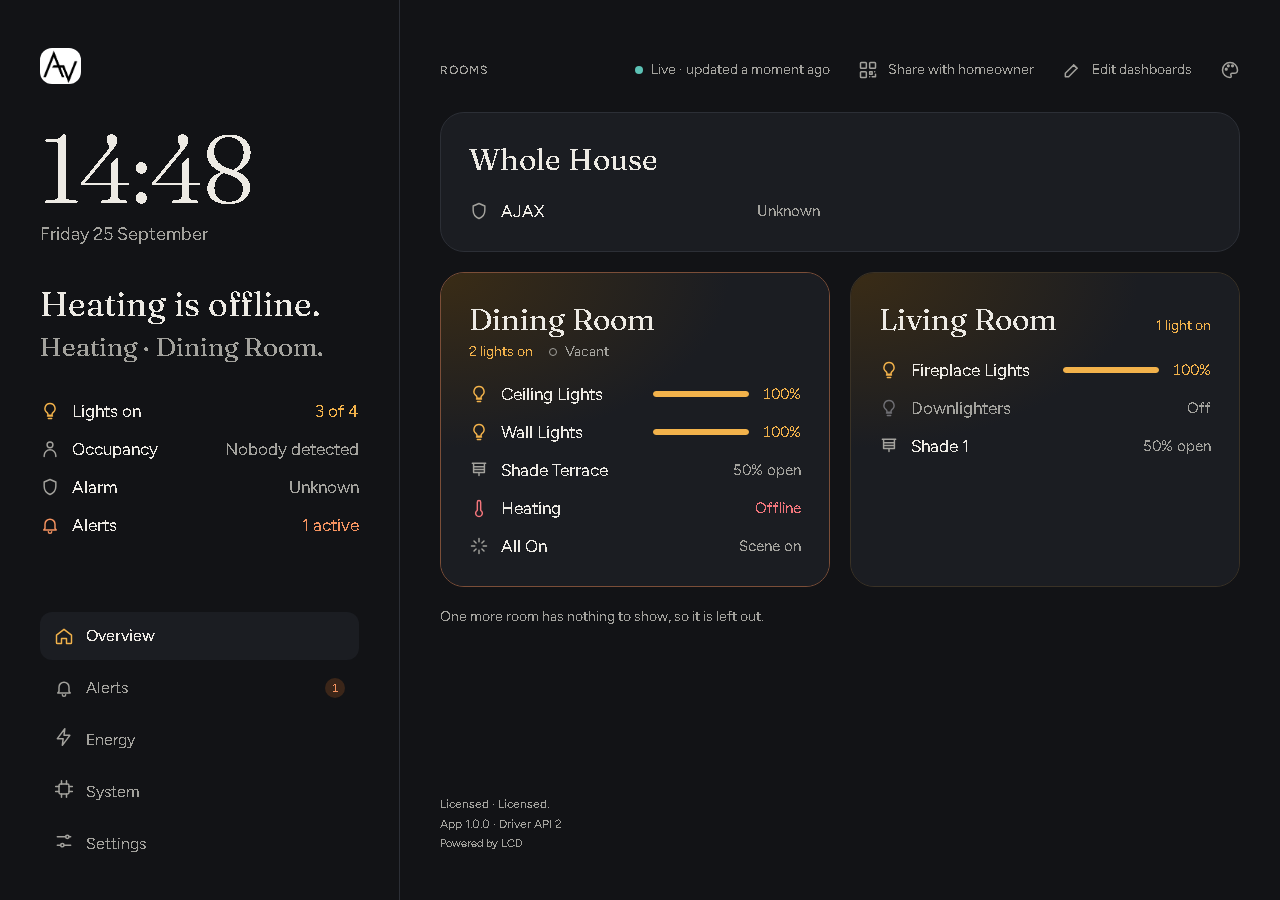
LCD Dashboard gives you the whole-house view on the Crestron Home system itself. It’s a Crestron Home driver, so it installs like any other driver and runs on the processor. There’s no extra computer, no cloud account and no app to install.
Open it in any browser on the home network and you get:
- Every room at a glance. Lights and levels, shades, doors and locks, occupancy, temperature and what’s playing.
- A summary of the whole house. Lights on, doors open, locks, devices offline and the security system.
- Alerts. A door left open, a device offline, a low battery or a security alarm. Each alert says what, where and for how long. Each kind of alert is also a Crestron Home event, so it can trigger a sequence.
- Energy estimates. Lighting energy and cost by room and by load, and lights left on in empty rooms.
- Your own dashboards. Build pages from cards, with separate layouts for phone, tablet and desktop.
- Wall tablet mode. Full screen, screen kept on, dimmed at night, in one of four styles.

Because it reads the house directly from Crestron Home, there’s nothing to keep in step. Add a room or a light in Crestron Home and it appears on the dashboard.

Side by side
| LCD Dashboard | Home Assistant alongside Crestron Home | |
|---|---|---|
| Extra hardware | None | A computer or appliance to run Home Assistant |
| Set-up | Install a Crestron Home driver | Install HA, add a community integration, build the dashboards |
| Whole-house view | Ready from the start | Once configured |
| Alerts for doors, offline devices, low batteries | Built in, thresholds set in the browser | Build your own automations |
| Alerts in Crestron Home sequences | Yes | Depends on the integration |
| Lighting energy estimates | Yes | Yes, once configured |
| Processor health and history | Yes | No |
| Installer branding | Logo, name and support details | No |
| Control | View only; control stays in the Crestron Home app | Depends on the integration |
| Who supports it | The Crestron installer and LCD | Whoever set it up |
| Cost | £200 per processor with a year of updates, 30-day trial | Free software, plus hardware and set-up time |
Home Assistant can do far more than show a dashboard, and for some homes it’s the right choice. If what you want is the dashboard, LCD Dashboard gets you there with much less to look after.
Good for installers too
For integrators, LCD Dashboard is a simple add-on that improves the handover. Give the homeowner a QR code or a printed card. They scan it on the home Wi-Fi and the dashboard opens on their phone, with your logo, company name and support number on it.

The installer view adds a System page with processor load, memory, storage and errors over 24 hours and 7 days, plus a troubleshooter. Alerts for a processor restart or climbing errors help you spot a problem before the client calls.
Things to know
- LCD Dashboard is for viewing. Homeowners keep using the Crestron Home app, keypads and touch screens for control.
- It works on the home network only. There is no remote access.
- Devices added by some third-party drivers show in part or not at all. Check on site before promising a device.
- Energy figures are estimates based on dimmer levels and the watts you enter.
- It needs a 4-series Crestron Home processor.
Try it
LCD Dashboard costs £200 per processor, including updates for one year from purchase, and comes with a 30-day free trial. Start a trial from the LCD Dashboard store page, download the driver from the LCD Dashboard driver page, and follow the set-up guide on the LCD docs site.
If your clients have been asking for a Home Assistant-style dashboard, this is the one that runs on the Crestron system they already own.